Contact: Mr. Wang
Telephone:18819029672
Email: dy012@dm-robot.com
Website: www.xdm-robot.com/
Address: No. 5, Baihao Taikang Street, Houjie Town, Dongguan City, Guangdong Province
A linear motor can be regarded as a rotating motor cut and unfolded along a radial plane. The resulting linear servo motor is an electromagnetic direct drive linear motor that can cause linear motion without contacting parts, eliminating gaps, winding, wear and maintenance problems. Linear movement does not require pneumatic or hydraulic cylinders, nor does it require rotational movement to be converted into linear movement through gearboxes, spindles, belts, racks and pinions or screws. Linear motors are currently used in robots, scoring mechanisms, precision workbenches /workbenches, fiber and photonic alignment and positioning, installation, pickup and placement systems, machine tools, semiconductor equipment, electronics manufacturing, detection systems that require high bandwidth responsive manipulation, vision systems and many other industrial-scale motion manipulation applications.
When the translational motion needs to be performed dynamically with low conflict and high flexibility, the core of the user-selected linear system drive system consists of control electronics, servo drives and linear motors. The magnetic structure of the shaft is made in such a way that there is no space between each magnet, completely supported by itself, and then the magnetic structure is pierced into the protective stainless steel tube.
The linear motor is tubular electromagnetic direct drive, the linear motion is purely electric and wear-free, without any mechanical gearbox, spindle or belt center coupling. The linear motor consists of two parts: a slider and a stator, which is made of neodymium magnets, which are mounted in high-precision stainless steel tubes. The stator contains motor windings, slider bearings, azimuth capture sensors and microprocessor circuits for monitoring the motor.
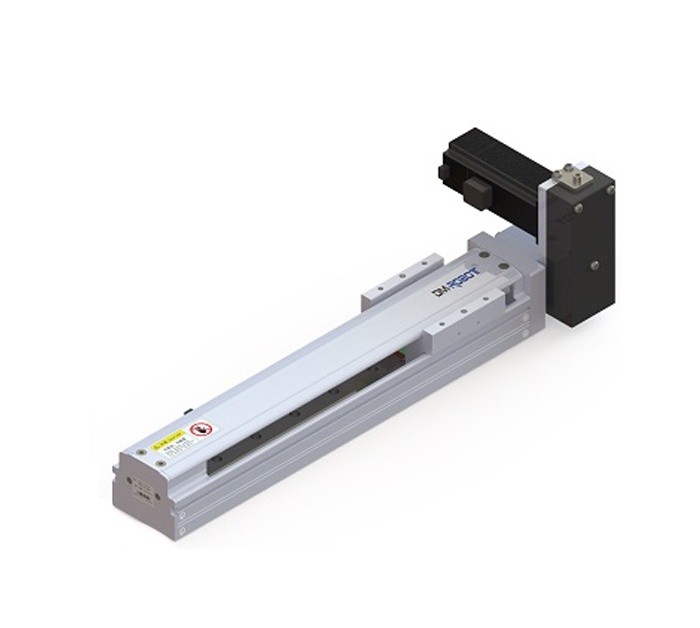
The coils of linear shaft motors adopt a cylindrical design, which has many key advantages compared to other linear motors. The cylindrical design of the coil components is very solid, without the need for external reinforcement materials (i.e. the iron used by plate-type linear motors). The coils around the magnets allow the best use of all magnetic flux. As long as the force is not in contact with the shaft, the linear force does not change, and the magnetic flux cuts the motor winding at right angles to obtain the highest power. All sides of the coil should be able to dissipate heat to the maximum extent. Higher power linear shaft motors require less power in a compact design, while simultaneously generating a force comparable to that of a conventional linear motor of equal size.
There are three basic concepts for the design of a linear shaft motor: simple, high-precision, and non-contact. They consist of only two parts, a magnetic shaft and a cylindrical coil "force". They do not have the accuracy of the iron in the clamp or shaft and zero cogs, and the coils form the core linear shaft motor, providing the required stiffness of the core motor, linear shaft motor right-fault contact type. Since the coil is completely wrapped around the magnet, all magnetic fluxes are effectively used. This allows for a larger (0.5 to 5.0 mm) nominal annular air gap, which is critical, meaning that the force does not change as the air gap changes with the stroke of the device.
in conclusion
Azimuth sensors are generally installed inside a linear motor. When the linear motor stops and during movement, the current orientation of the linear motor is measured and supervised. The azimuth error is immediately detected and reported to the superior operator. The linear motor can be positioned freely within the entire stroke range. In addition, both travel speed and acceleration can be controlled accurately, and for more complex movements, any stroke curve can be saved as curves in the servo drive and executed by the motor at the desired speed.Precision linear guide rail

Tel: +86 18819029672
Add: A801-004, Tian'an International Building, No.3012,
Renmin South Road, Jiabei Community, Nanhu Street,
Luohu District, Shenzhen, China.