Contact: Mr. Wang
Telephone:18819029672
Email: dy012@dm-robot.com
Website: www.xdm-robot.com/
Address: No. 5, Baihao Taikang Street, Houjie Town, Dongguan City, Guangdong Province
Linear motors are also called linear motors, linear motors, linear motors. Intuitively, this kind of motor "opens" the mover and stator of our common motor, directly converting electrical energy into linear motion mechanical energy (usually the motor generates torque), without any central conversion of the transmission device. However, the shape of linear motors may not be "linear". It has a very important feature that the moving part of the linear motor has an end point, but our common rotating motor is constantly rotating.
From a large number of usage occasions, linear motors can be divided into "low acceleration" motors and "high acceleration" motors. High-acceleration linear motors generally have shorter strokes and can increase an object to a very high speed within a short distance. They are generally used in weapons, military industry or aerospace fields. Low-acceleration linear motors are more affordable and are commonly found in magnetic levitation trains, roller coasters, and perhaps other forms of ground transportation. This use is most common in the field of automation control. Especially in recent decades, with the increase in industrialization, industrial products have become increasingly integrated and have higher accuracy requirements. More and more linear motors have replaced screw guides and become indispensable equipment for automated production lines.
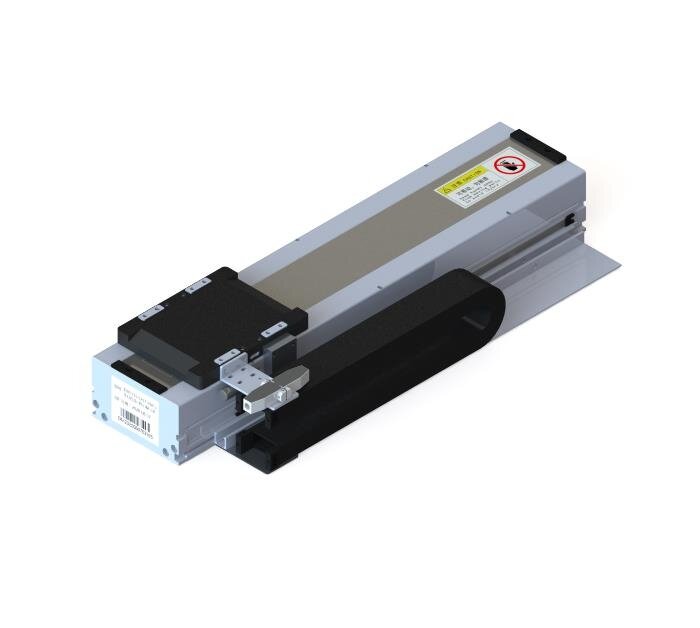
Compared with rotary motors, linear motors have the following advantages:
1. Simple structure
Since linear motors do not require additional devices to turn rotational motion into linear motion, the structure of the system itself is greatly simplified and the components and volume are greatly reduced.
2. High accuracy
Where linear motion is required, the linear motor can complete direct transmission, so it can eliminate various positioning errors caused by the central link and improve accuracy. If the algorithm built in the operator is passed, the collision resistance, cogging force, gravity and even temperature rise errors during operation can be compensated in real time, greatly improving the system accuracy.
3. Fast response speed, high sensitivity and good follow-up
The linear motor simply enables its motor to be supported by magnetic levitation, so that a certain air gap is always maintained between the motor and the stator without contact, which eliminates the resistance to contact conflict between the stator and the stator, thus greatly improving the sensitivity, speed and follow-up of the system. The motor runs fast in one aspect, and stopping correctly is an important goal in considering the functions of linear motors. Through the built-in algorithm of the operator, taking into account multiple factors such as stroke and load, the motor is instructed to speed up and decelerate in real time to ensure that the linear motor can stop at the specified direction and the accuracy can reach microns.
4. Work safe and reliable, long life
The linear motor can complete contactless transmission force, and the mechanical conflict loss is almost zero, so there are fewer faults, no repairs, and greatly reduce energy consumption.

Tel: +86 18819029672
Add: A801-004, Tian'an International Building, No.3012,
Renmin South Road, Jiabei Community, Nanhu Street,
Luohu District, Shenzhen, China.